SMuRF
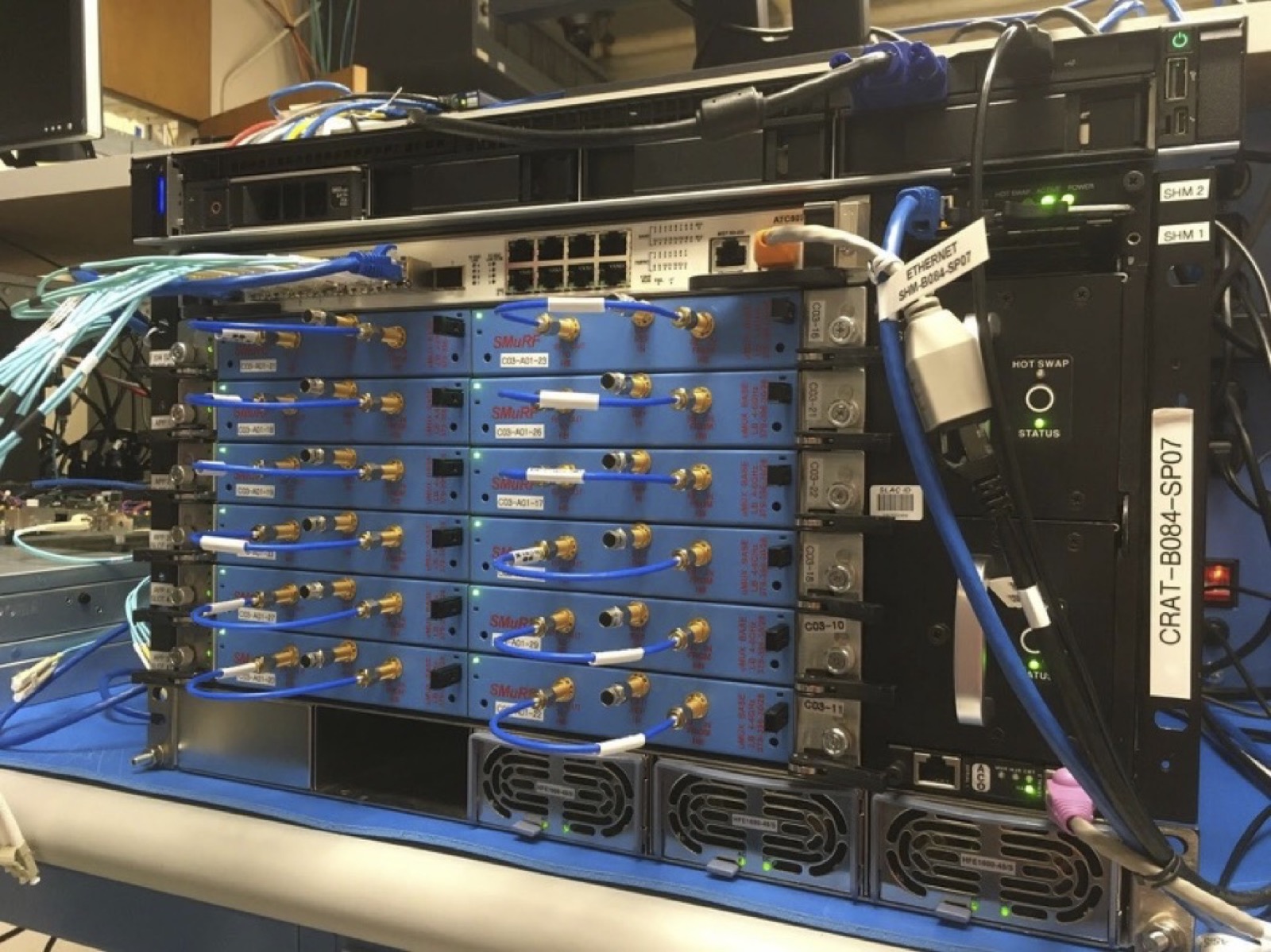
SMuRF, the SLAC Microresonator Radio Frequency electronics, is the warm readout system for microwave SQUID multiplexed superconducting sensors. Each detector is coupled to its own superconducting microresonator with a distinct resonant frequency. A single coaxial line carries a comb of microwave probe tones past all of them, and the readout job is to generate that comb, follow what each resonator does to its tone, and turn the result back into a detector timestream. SMuRF does this in warm digital electronics, and the specific thing it does differently is track.
Tone tracking
A conventional readout parks a fixed tone at each resonance. That works until the detector responds: as the sensor’s inductance changes, its resonance moves, and the fixed tone slides down the side of the dip. The signal then appears as a large amplitude swing on a tone that is no longer where it should be.
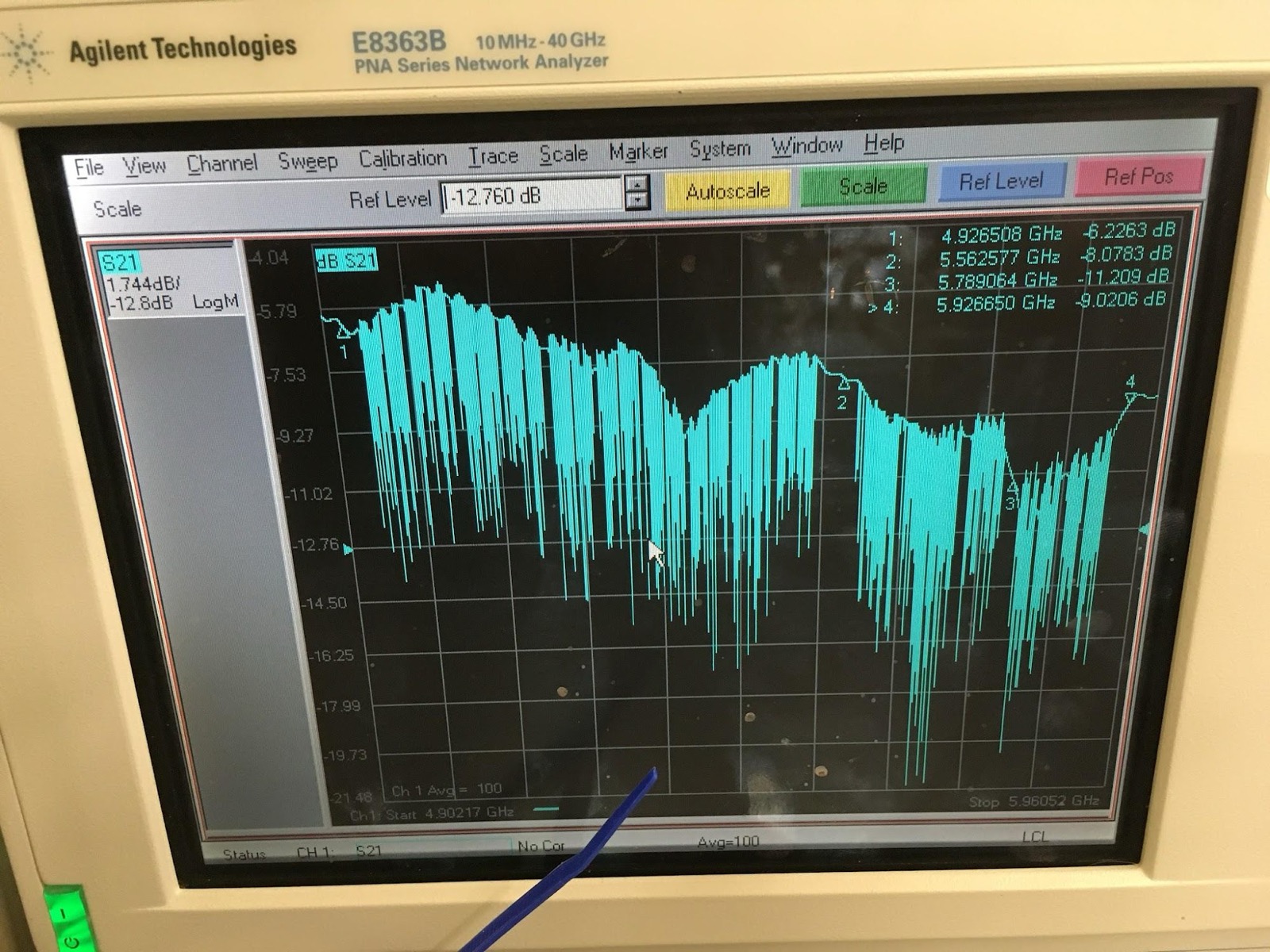
The cost of that is paid in the cryogenic amplifier. Every tone in the comb passes through the same first-stage amplifier at once, and the amplifier has to carry all of them simultaneously without driving itself into a regime where the tones intermodulate and generate spurious products on top of real channels. The limit is total power, so the dynamic range each channel demands sets how many channels can share the line. This, rather than anything about the resonators themselves, is the practical bottleneck on multiplexing factor.
SMuRF instead measures where each resonance has moved and steers the drive tone to follow it. Because the tone stays on resonance, the amplitude excursion the amplifier chain has to carry stays small, and the detector signal is recovered from the frequency correction rather than from the amplitude. Lowering the dynamic range requirement per channel is what allows the channel count to grow. My group developed the technique to a 1000× multiplexing factor for transition-edge sensor bolometers, and demonstrated a 1820-channel multiplexer with NIST Boulder in 2025.
The tracking loop runs independently on every resonator, and faster than the sky signals being recorded. A feedforward path on top of that feedback allows fast signal modulation, which buys further control over instrument noise.
The resonator chip designs themselves are the work of NIST Boulder. SMuRF is the warm electronics and the algorithms that drive them.
Where it runs
A single SMuRF board manipulates 3,328 resonators, and a crate of six carries roughly 20,000 channels. My group designed, prototyped, validated, fabricated and delivered the SMuRF warm readout electronics for the Simons Observatory cameras, and for the readout system of the Advanced Simons Observatory expansion. SMuRF reads out 98,000 transition-edge sensors at the Simons Observatory, which as of 2026 is the largest deployment of microwave SQUID multiplexing for TES bolometers anywhere. The same electronics are in use for X-ray calorimetry and for quantum device measurement.
Beyond the CMB
Nothing about tone tracking is specific to millimeter-wave astronomy. Any experiment that needs to read many superconducting sensors through a limited number of cold lines faces the same amplifier dynamic range problem, and dark matter, neutrino and quantum information experiments increasingly do.
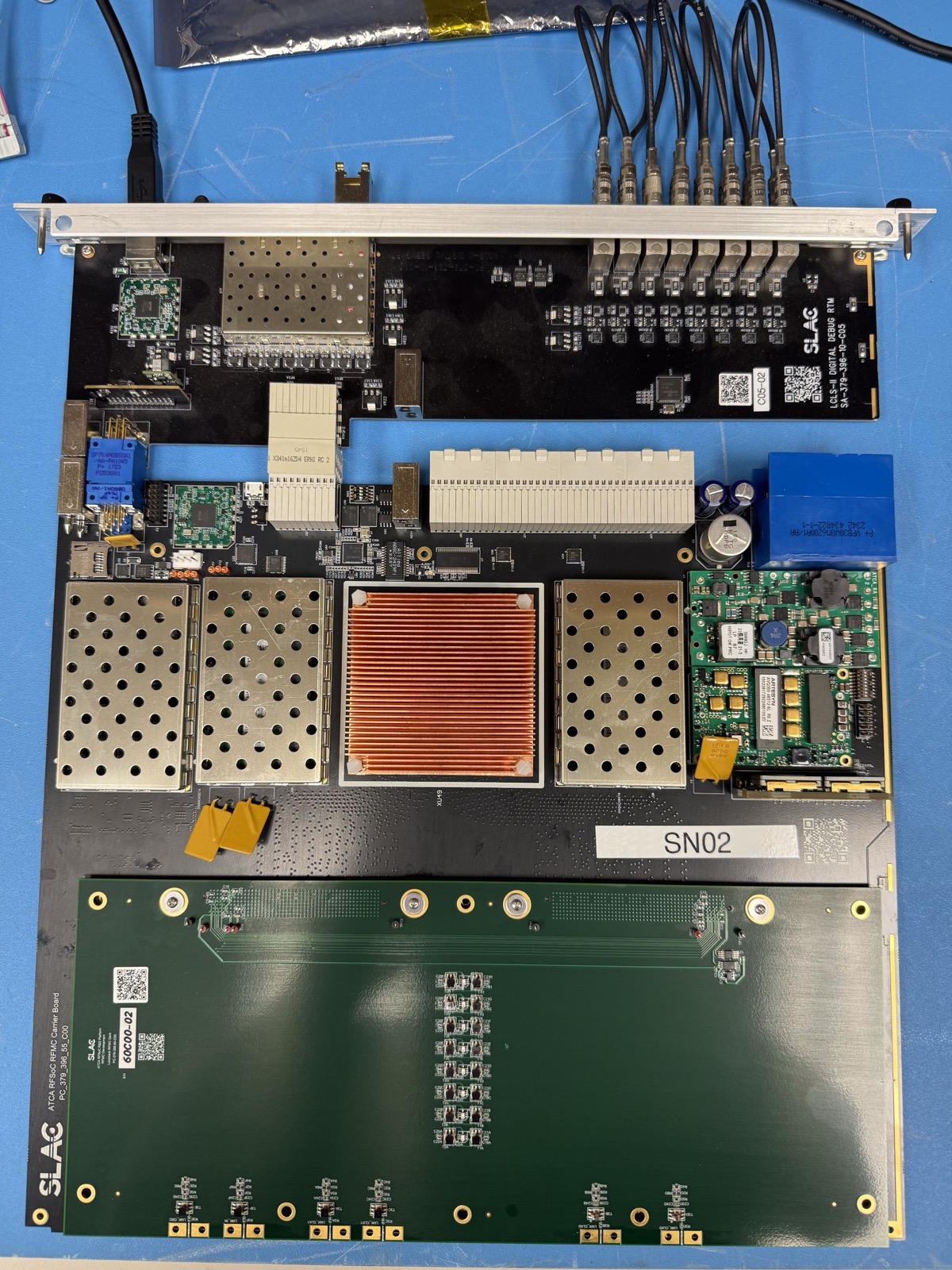
SPECTRA, the Scalable Platform for Experiment Control, Tone-tracking, and RF Acquisition, is an open-source RFSoC-based readout platform developed with Fermilab and the University of Chicago that pairs SMuRF tone tracking with QICK pulse control. The combination spans two regimes that are usually served by different instruments: high channel density resonator arrays on one side, and MHz-bandwidth readout of individual quantum sensors on the other. It is intended for future CMB and submillimeter surveys alongside dark matter searches, coherent elastic neutrino-nucleus scattering experiments, and rare-event searches.
It is SMuRF moved off custom FPGAs and proprietary firmware: an RFSoC with an RF daughter card, deployable on an evaluation board, a QICK box, or a SLAC ATCA carrier depending on how many channels an experiment needs, with firmware variants for bolometers, calorimeters and qubit-based sensors. It also runs edge-AI on the readout itself, classifying the non-Gaussian events that qubit-based sensors produce in real time, alongside triggering and calibration.
If you are reading this from the dark matter or quantum sensing side, the practical summary is that the hard engineering of scaling superconducting sensor readout has largely been done and is available to you. The warm electronics are built, the firmware is open, and the technique has operated continuously on a deployed instrument with tens of thousands of channels for years.
My first experiment was a dark matter search, and the sensing techniques I have worked on since are finding their way back into that field.
Selected references
- Irwin, K. D. and Lehnert, K. W. Microwave SQUID multiplexer. Applied Physics Letters 85, 2107 (2004).
- Mates, J. A. B. The Microwave SQUID Multiplexer. PhD dissertation, University of Colorado Boulder (2011).
- Dober, B. et al. A microwave SQUID multiplexer optimized for bolometric applications. Applied Physics Letters 118, 062601 (2021).
- Yu, C. et al. SLAC microresonator RF (SMuRF) electronics: A tone-tracking readout system for superconducting microwave resonator arrays. Review of Scientific Instruments 94, 014712 (2023).
- Groh, J. C. et al. Demonstration of a 1820 channel multiplexer for transition-edge sensor bolometers. Applied Physics Letters 127, 152602 (2025).
- Groh, J. C. et al. Crosstalk Effects in Microwave SQUID Multiplexed TES Bolometer Readout. Journal of Low Temperature Physics (2024).
- Henderson, S. W. et al. Highly-multiplexed microwave SQUID readout using the SLAC Microresonator Radio Frequency (SMuRF) electronics for future CMB and sub-millimeter surveys. Proc. SPIE 10708, 1070819 (2018).
- Kernasovskiy, S. A. et al. SLAC Microresonator Radio Frequency (SMuRF) Electronics for Read Out of Frequency-Division-Multiplexed Cryogenic Sensors. Journal of Low Temperature Physics 193, 570 (2018).
- Liu, C. et al. Development of RFSoC-based direct sampling highly multiplexed microwave SQUID readout for CMB and submillimeter surveys. Proc. SPIE 13102, 1310211 (2024).