How structure grew
The same CMB photons that carry the inflationary signal have traveled through all the structure that formed after recombination. Gravitational lensing deflects them, and reconstructing those deflections maps the total matter distribution. Combined with galaxy surveys, CMB lensing constrains the sum of neutrino masses, the behavior of dark energy, and the relationship between galaxies and the dark matter halos they occupy.
Lensing is not the only thing the CMB picks up on the way. The Sunyaev Zeldovich effects record the hot gas the photons pass through: the thermal effect tracks the pressure of electrons in that gas, and the kinetic effect their bulk momentum. Together with lensing they turn the CMB into a probe of where the matter is, how hot it is, and how it is moving, which is a different and complementary handle on structure formation from the one galaxy surveys provide.
The Simons Observatory
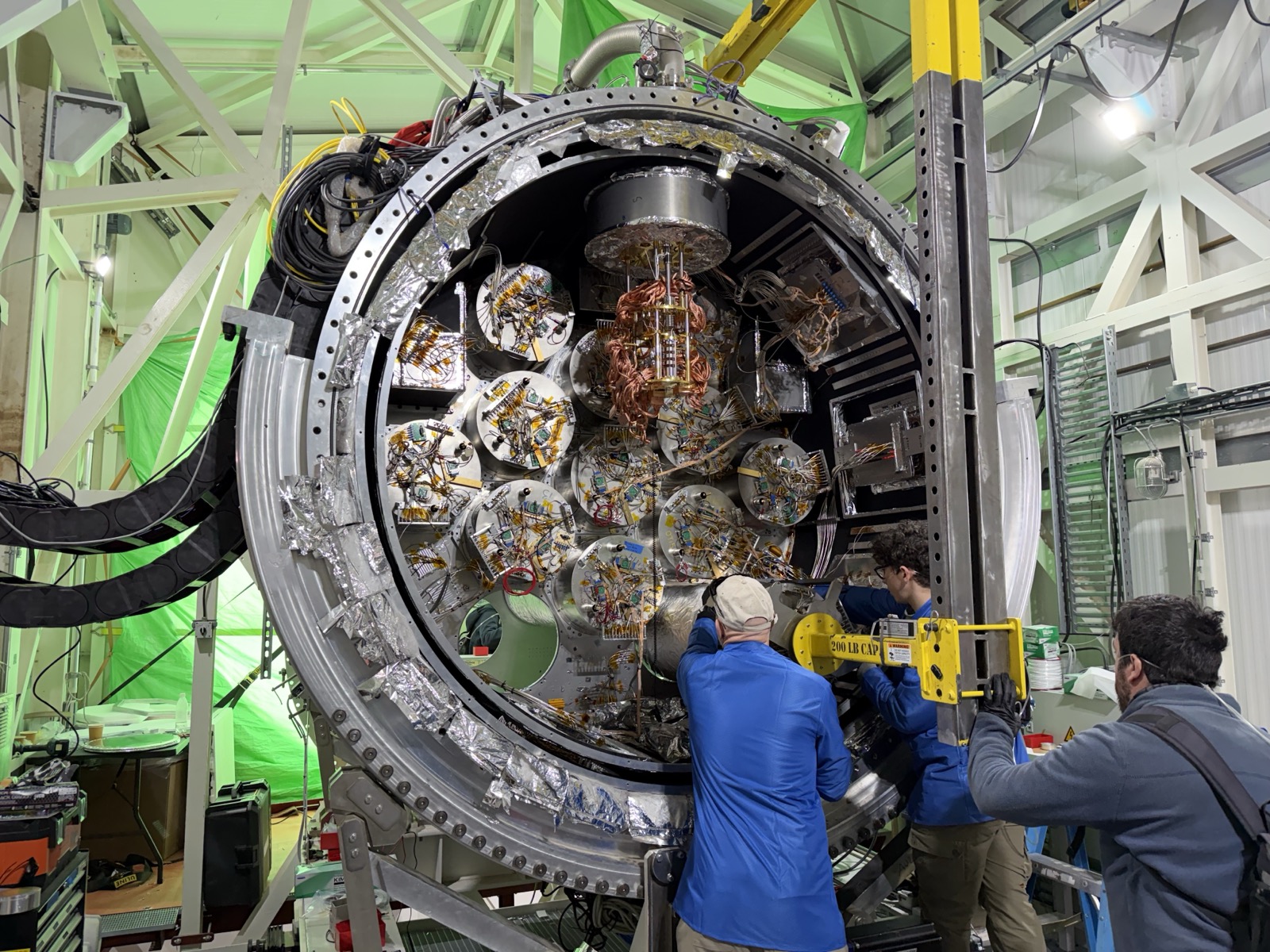
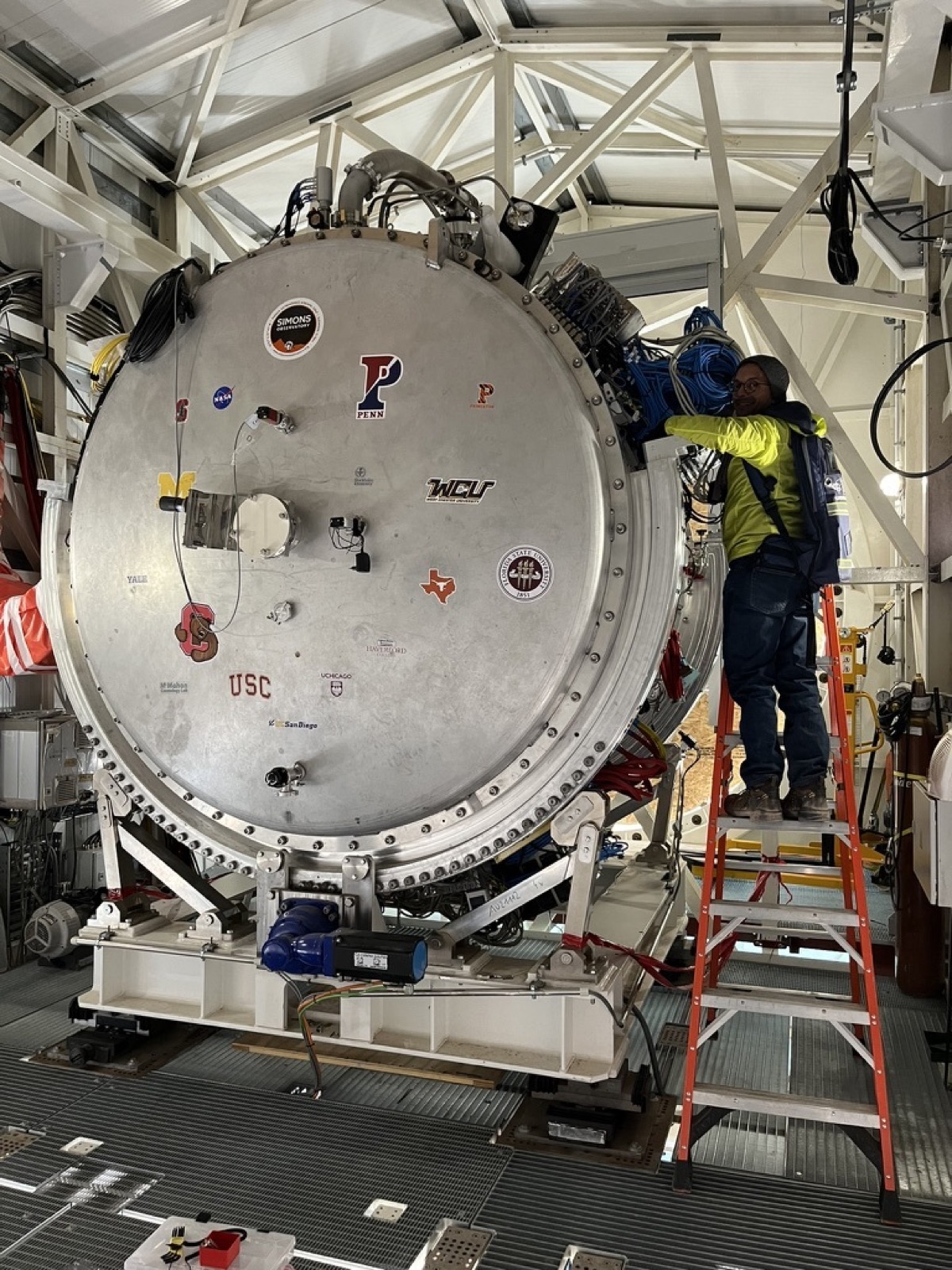
I pursue this with the Simons Observatory, in the Parque Astronómico de Atacama in northern Chile. The six-meter Large Aperture Telescope achieved first light in February 2025. My group built the detector readout electronics for the observatory. I am a co-investigator on the NSF-funded Advanced Simons Observatory project, leading the SLAC scope for the expanded observatory’s readout system.
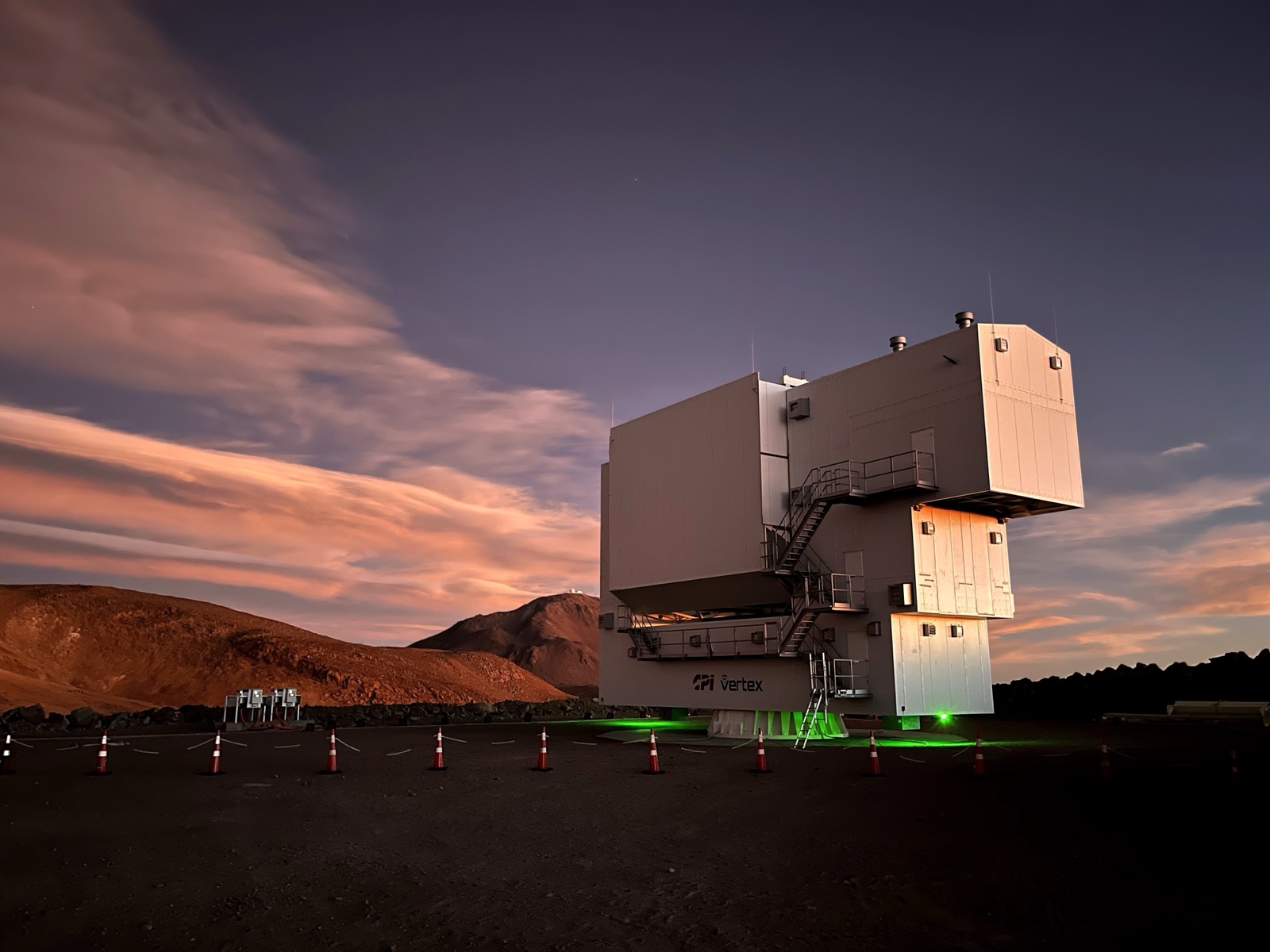
Lensing reconstruction requires a large-aperture telescope. The deflections being measured are small and correlated on arcminute scales, so the instrument has to resolve them, which is where a six-meter dish comes in handy. It also has to cover a wide enough area of sky for sufficient statistical sampling, which sets the scale of the camera and, in turn, of its readout.
What my group is doing with the data
My group is carrying out a comprehensive study of potential instrument systematic effects on CMB lensing reconstruction with Large Aperture Telescope data, running from 2025. That includes readout crosstalk studies that quantify the level of the systematic and propagate it through map making into the lensing estimator, where its effect on the reconstructed lensing power can actually be judged. The group also handles source removal, null tests and results validation for lensing reconstruction with the telescope’s Initial Science Observations, with publications in preparation.
Crosstalk is a good example of why building the readout and doing the analysis in the same group is useful. A small amount of signal leaking between multiplexed channels is an instrumental effect with a known origin in the hardware, but whether it matters depends entirely on how it propagates through map making into a quadratic estimator that is itself built from products of the map. The question cannot be answered from either end alone.
Group members also work on the large-scale structure science these maps feed: cross-correlations between CMB lensing and galaxy surveys, and 21 cm and millimeter-wave line intensity mapping as routes to structure at higher redshift than galaxy catalogs reach.
Recent results
Jia ‘Frank’ Qu and colleagues published unified and consistent structure growth measurements from joint ACT, SPT and Planck CMB lensing in Physical Review Letters 136, 021001 (2026), doi:10.1103/k5yr-3h6d.
My group, with the CHIME collaboration, measured the squeezed bispectrum between CHIME H I emission and Planck CMB lensing, and forecast what future data will reach, in The Astrophysical Journal 1005, 73 (2026), doi:10.3847/1538-4357/ae77e6.